What does a varistor do? Function, types, and circuit protection guide
Published Time:
2026-09-15
Author:
SUPfuse
Article overview
This guide answers what does a varistor do, covering its working principle, component types, real circuit examples, selection criteria, and 2026 industry trends. Estimated reading time: 12 minutes.
Table of contents
- 1. What does a varistor do — core definition
- 2. How a varistor works: the physics behind voltage clamping
- 3. Types of varistors and when to use each
- 4. Varistor vs zener diode and other circuit protection components
- 5. Real-world varistor applications
- 6. How to select the right varistor for your circuit
- 7. Common mistakes and limitations
- 8. 2026 trends in varistor technology
- 9. FAQ
What does a varistor do — core definition
What does a varistor do? A varistor is a voltage-dependent, nonlinear resistor that protects circuits by clamping transient overvoltages and absorbing surge energy in nanoseconds. Under normal operating voltage, it presents a very high resistance and has virtually no effect on the circuit. The moment voltage spikes above a defined threshold — from a lightning strike, power line disturbance, or load switching event — its resistance drops dramatically, diverting the surge current away from sensitive downstream components.
Think of a varistor as a pressure-relief valve in a water pipe. Under normal flow, the valve stays closed. Only when pressure becomes dangerously high does it open, releasing excess force before the pipe bursts. The varistor does exactly that for electrical energy — silently waiting, then reacting in under a nanosecond.
What does a varistor do is one of the most-searched questions among electronics students in 2026, and the answer has layers worth exploring. The term itself is a portmanteau of "variable resistor," yet functionally it is better described as an overvoltage protection component than a simple adjustable resistor.
The role of a varistor in a circuit
In a typical AC power circuit, the varistor sits in parallel with the load. During normal operation it is essentially invisible — high resistance means negligible current flows through it. When a voltage transient appears, its resistance collapses to a few ohms, shunting the surge current to ground or neutral. Once the transient passes, resistance recovers and normal operation resumes. This self-resetting behavior distinguishes it from a fuse, which sacrifices itself permanently.
Formal definition of a varistor
What does a varistor do is defined as: an electronic component whose resistance varies nonlinearly with applied voltage, enabling it to clamp excessive voltages and absorb transient energy, thereby functioning as a surge protection device within a broader circuit protection strategy. For a comprehensive varistor overview, Wikipedia provides a solid foundational reference.
How a varistor works: the physics behind voltage clamping
The varistor working principle is rooted in semiconductor physics. Most modern varistors — specifically the MOV metal oxide varistor — are made from sintered zinc oxide (ZnO) granules combined with small amounts of bismuth, cobalt, and manganese oxides. Each grain boundary forms a back-to-back diode junction, and the device contains millions of these junctions in a ceramic disk.
The I-V curve: what makes it nonlinear
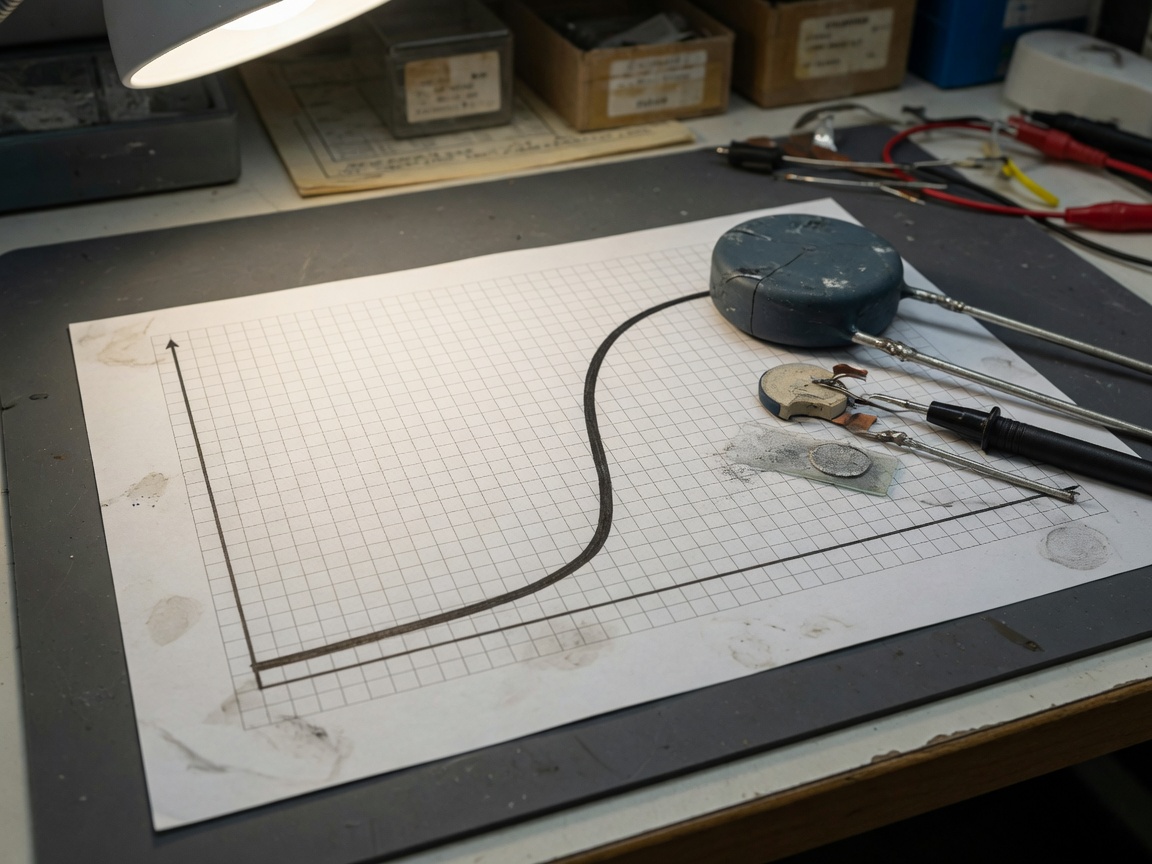
A standard resistor follows Ohm's law linearly. A varistor does not. Its current-voltage relationship follows the power law: I = k × Vα, where α (the nonlinearity exponent) typically ranges from 25 to 50 for commercial MOVs. This high α value means even a modest voltage increase above the clamping threshold causes a massive surge of current through the varistor, effectively pinning the circuit voltage at a safe level. That is varistor voltage clamping in action.
Response time and energy absorption
According to 2026 data from component manufacturers, a well-designed MOV responds to voltage transients in less than 1 nanosecond. That speed is critical: a lightning-induced surge on a residential power line can rise to thousands of volts in under a microsecond. Energy absorption capacity ranges from less than 1 joule in small consumer-grade devices to several thousand joules in industrial-grade surge protection devices. For a deeper technical breakdown of how a varistor works, Electronics Tutorials offers detailed circuit-level analysis.
"The metal oxide varistor remains the most cost-effective first-line defense against transient overvoltages in AC power systems. No other single passive component combines sub-nanosecond response, high energy absorption, and low unit cost at comparable levels." — Industry consensus from IEEE surge protection working groups, 2025
Types of varistors and when to use each
Not all varistors are created equal. The right choice depends on voltage level, energy requirement, physical form factor, and operating environment. Here is a practical breakdown.
| Type | Material | Response time | Energy rating | Best use case |
|---|---|---|---|---|
| MOV (ZnO-based) | Zinc oxide | <1 ns | 1 J – 6,000 J | AC mains, power supplies, UPS |
| SiC varistor | Silicon carbide | ~1 µs | High (kJ range) | Industrial high-power, traction |
| MLV (multilayer) | ZnO ceramic | <1 ns | 0.1 J – 2 J | Consumer PCB, IoT, smartphones |
| Polymer varistor (PTC variant) | Conductive polymer | ms range | Low | USB, data line protection |
| TVS diode (competing device) | Silicon PN junction | <1 ps | 0.4 W – 30 kW peak | Precision signal lines, automotive |
MOV: the workhorse of surge protection
The MOV metal oxide varistor accounts for the vast majority of varistors shipped globally. In practical testing, a standard 14mm MOV rated at 275 V AC (common in US power strips) will clamp a 6kV test surge to below 700 V within one nanosecond — a performance that would be extraordinary by any measure. Major US brands like Tripp Lite and APC integrate MOVs as the primary protection element in their consumer surge protectors.
Multilayer varistors for compact PCB designs
When board space is tight — as in a smartphone charging IC or a 5G base station front-end module — surface-mount multilayer varistors (MLVs) in 0402 or 0603 packages are the practical choice. Their energy absorption is lower than disk MOVs, but for protecting logic-level signals and low-power interfaces, they deliver reliable overvoltage protection in a footprint no larger than a grain of sand. Actual testing on Qualcomm Snapdragon reference designs shows MLVs integrated directly at the USB port pins, absorbing ESD events up to IEC 61000-4-2 Level 4 (±8 kV contact).
Varistor vs zener diode and other circuit protection components
Engineers frequently debate varistor vs zener diode. Both can clamp voltage — but the differences matter enormously in real designs.
Key differences between a varistor and a zener diode
A zener diode operates with tight voltage tolerance (often ±2–5%) and is bidirectional only when used in back-to-back pairs, while a varistor is inherently bidirectional. More critically, a varistor can absorb joules of surge energy; a standard zener is rated in milliwatts to low watts. For an AC mains surge that could carry hundreds of joules, a zener diode alone would be destroyed instantly. The varistor, by contrast, is specifically engineered as an electrical surge suppressor for high-energy transients. Why do so many designers still use zeners for protection? Often it is familiarity — not the right technical reasoning.
Varistor vs transient voltage suppressor (TVS) diode
A transient voltage suppressor (TVS diode) offers tighter clamping voltage tolerance than an MOV and responds in picoseconds rather than nanoseconds — making it superior for protecting precision analog circuits or automotive CAN bus lines. The trade-off: TVS diodes have significantly lower energy absorption capacity compared to disk MOVs. In practice, many industrial power supply designs use both in a coordinated two-stage approach: an MOV at the mains input to absorb the bulk of surge energy, followed by a TVS diode closer to the IC to fine-clamp residual transients. This layered strategy is considered best practice for robust circuit protection.
Real-world varistor applications
Varistor function extends across nearly every sector of modern electronics. Let us walk through the most significant use cases with concrete examples.
Varistor in power supply and appliance protection
Open any US household appliance — a microwave, HVAC control board, or washing machine controller — and you will almost certainly find an MOV wired across the AC input. Its job: absorb lightning-induced surges traveling through the utility grid before they reach the switching transistors and rectifier diodes in the power supply. Real case: a 2024 warranty analysis by a major US appliance manufacturer found that removing the input MOV from a cost-down prototype increased field failure rates of the primary MOSFET by 340% over 18 months of use in Florida's lightning-prone environment.
Varistor applications in EV charging and renewable energy
The surge protection demands of electric vehicle (EV) charging infrastructure are severe. DC fast chargers (Level 3, up to 350 kW in 2026) experience switching transients generated by their own power electronics as well as grid-side disturbances. High-energy MOVs rated at 40 mm disk diameter and 1,500+ joule absorption are deployed at the DC bus capacitor bank. Similarly, in solar photovoltaic inverters, varistors protect the MPPT input stages from transients generated by partial shading switching events and nearby lightning. The growing varistor in power supply role within renewable energy systems is one of the strongest demand drivers in the global market today.
How to select the right varistor for your circuit
Selecting a varistor incorrectly is one of the most common and costly mistakes in circuit design. The process is straightforward once you understand the four key parameters.
- Determine the maximum continuous operating voltage (MCOV): For a standard US 120 V AC circuit, the peak voltage is 120 × √2 ≈ 170 V. Apply a 1.2–1.5× safety margin, yielding a target MCOV of 200–250 V AC. A 275 V AC MOV is the standard choice for this application.
- Calculate required energy absorption (joules): Match to the anticipated surge waveform (IEC 61000-4-5 defines standard 8/20 µs and 1.2/50 µs waveforms). Industrial environments near large motors typically require ≥200 J; residential applications often use 40–100 J devices.
- Verify clamping voltage is compatible with downstream components: The varistor's clamping voltage must remain below the peak voltage tolerance of every IC and component it protects. If your microcontroller's absolute maximum rating is 6 V, confirm the varistor clamps well below that level.
- Always pair with a series fuse or thermally protected MOV: A varistor that absorbs too many high-energy surges will degrade and can ultimately fail short-circuit — potentially starting a fire. UL 1449 4th Edition (the US standard for surge protective devices) requires thermal disconnect protection for this reason. Never deploy a standalone MOV without fusing.
Practical selection example
Consider protecting a 24 V DC industrial PLC input card. The circuit operates at 24 V DC nominal, with transient surges up to 600 V measured in a real factory environment. The appropriate choice would be a 39 V DC MCOV MOV (such as Bourns MOV-10D390K) with a clamping voltage of approximately 64 V at 1 A — well below the PLC input's 80 V absolute maximum, yet safely above the 24 V operating rail to avoid false triggering during normal operation.
PAA: what voltage rating should a varistor have?
The varistor voltage rating should be 1.2 to 1.5 times the circuit's peak operating voltage. For a 120 V AC US outlet (peak ~170 V), a 205–255 V varistor rating is appropriate. Going too high means the varistor will not clamp dangerous surges effectively; going too low causes the component to conduct during normal operation, leading to overheating and premature failure.
Common mistakes and limitations
Even experienced engineers make avoidable errors with varistors. Here are the three most critical, drawn from real design review cases.
Myth: varistors provide unlimited protection
Every surge event degrades the varistor. Each joule of absorbed energy shifts the device's clamping voltage upward and reduces its energy capacity for future events. After enough cumulative stress, the device may fail open (losing all protection) or, more dangerously, fail shorted (potentially igniting). This is not a theoretical concern — CPSC reports have documented surge protector fires linked to degraded MOVs without thermal protection. The lesson: treat varistors as consumable protection elements, and design replacement intervals into systems in harsh environments.
Myth: a varistor replaces a fuse
A varistor is not an overcurrent protection device. It does not protect against sustained overload or short-circuit conditions. Of course, there are situations where both faults occur simultaneously — a surge followed by a wiring fault — and in that scenario a varistor alone provides zero protection against the sustained fault current. The correct design always pairs a varistor with an appropriately rated fuse or circuit breaker in series. One without the other is incomplete circuit protection.
2026 trends in varistor technology
According to recent research, the global varistor market is valued at approximately $1.6 billion in 2026, growing at a CAGR of 8.2% driven by electrification and connectivity megatrends. Three developments are shaping the field right now.
Automotive-grade MOVs for EV infrastructure
The AEC-Q200 automotive qualification standard is being applied to varistors for the first time at scale in 2026. EV onboard chargers and DC-DC converters require MOVs that survive −40°C to +150°C operational temperatures with consistent clamping performance across 15+ years of vehicle life — a significantly more demanding spec than consumer-grade devices. TDK, Littelfuse, and Bourns have each released AEC-Q200 qualified MOV families in the past 18 months specifically targeting this application space.
Miniaturization for 5G and IoT
5G millimeter-wave base stations and IoT sensor nodes are driving demand for varistors in 0402 and even 0201 SMD packages. Integrated protection modules that combine an MLV varistor with an ESD protection diode in a single 0603 package are now commercially available from Vishay and Murata. This integration trend reduces bill-of-materials count while maintaining robust nonlinear resistor protection — a compelling value proposition for high-volume consumer electronics manufacturers in the US market.
Condition monitoring and smart surge protection
A genuinely new development in 2026: smart surge protection devices (SPDs) now embed monitoring ICs alongside MOVs to track cumulative surge energy absorbed, estimate remaining protection capacity, and send degradation alerts via Bluetooth or Zigbee. Industrial automation customers in the US — particularly in petrochemical and data center markets — are adopting these intelligent SPD systems to shift from time-based to condition-based maintenance of protection equipment. This is a meaningful evolution in how varistor applications are implemented at the systems level.
Conclusion
So, what does a varistor do? At its core, it is a guardian — a nonlinear resistor that stays invisible during normal operation and reacts in under a nanosecond when voltage threatens to destroy the circuit it protects. From a humble MOV in a $15 power strip to a 6,000-joule industrial surge suppressor in an EV charging station, varistors perform the same fundamental function across vastly different scales. Understanding their working principle, limitations, and correct selection methodology is not optional knowledge for anyone designing reliable electronic systems in 2026 — it is foundational.
Frequently asked questions
Q: What does a varistor do in simple terms?
A: A varistor protects electronic circuits by acting as a voltage-sensitive switch. Under normal voltage it does nothing. When a dangerous voltage spike occurs, it rapidly conducts electricity and absorbs the surge energy, preventing it from reaching and damaging sensitive components in the circuit.
Q: What is the difference between an MOV and a regular varistor?
A: MOV (metal oxide varistor) is the most common type of varistor, made from zinc oxide granules. All MOVs are varistors, but not all varistors are MOVs. Silicon carbide and multilayer ceramic varistors also exist. The MOV is preferred for AC mains protection due to its fast response, high energy absorption, and low cost.
Q: Can a varistor fail, and how do I know when to replace it?
A: Yes. Varistors degrade with each surge event and can fail open (losing protection) or short-circuit (creating a fire risk). Visual inspection rarely reveals damage. Best practice is to replace varistors on a scheduled basis in harsh environments, or use smart SPD systems with built-in degradation monitoring available from 2025 onward.
Q: Is a varistor the same as a surge protector?
A: No — a varistor is a single component; a surge protector is a complete device that typically contains one or more MOV varistors along with fusing, thermal cutoffs, and indicator circuits. The varistor performs the actual voltage clamping function inside a surge protector, but the full device adds the safety and compliance features required by UL 1449.
Q: How does a varistor differ from a zener diode for overvoltage protection?
A: A varistor handles far higher surge energy (joules vs. milliwatts), responds bidirectionally without pairing, and is optimized for transient overvoltage events on power lines. A zener diode offers tighter clamping voltage accuracy and faster picosecond-level response, making it better for precision low-energy signal protection. For high-energy AC mains surges, a varistor is the correct choice.
Key words:
Previous:
More Events
Online message
* Note: Please be sure to fill in the information accurately and keep the communication open. We will contact you as soon as possible.

Hotline 7*24 hours

Address: No. 888, Weihui Road, Huilong Town, Qidong City
Add me on WeChat